Nutrition Tips for Large Breed Dogs


Large breed dogs are in a class of their own, typically weighing more than 30 kg as adults. Their size brings strength, character, and unique nutritional needs.1 At Black Hawk, we know that feeding a large dog isn’t just about giving more food - it’s about providing nutrition that supports healthy growth, strong joints, and long-term wellbeing.
What Makes Large Breeds Unique
Large breed dogs grow more slowly than small breeds, often taking 12–24 months to reach full adult size.1 Their larger bones and joints require specific nutritional support to help prevent developmental issues such as hip dysplasia and joint stress.2
Although large breeds have slower metabolisms than small dogs, excess calories can still lead to rapid weight gain, which places additional strain on joints and organs.3 Maintaining a healthy body condition through appropriate nutrition is therefore essential for long-term health.
Why Kibble Size Matters
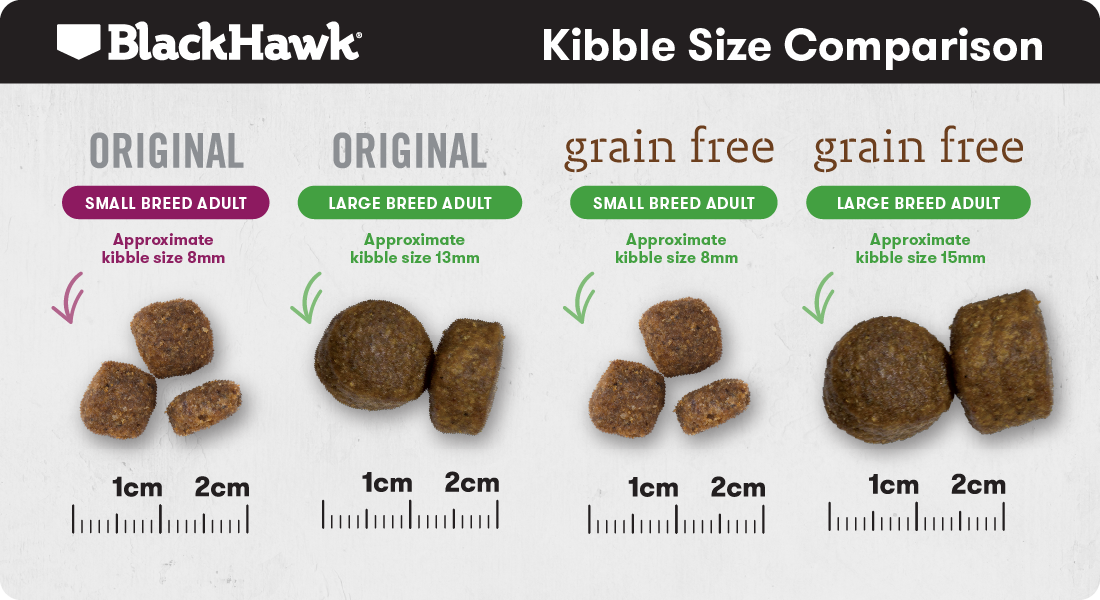
Appropriately sized kibble improves chewing efficiency, reduces the risk of choking, and supports normal ingestion in dogs with different jaw sizes and bite forces. For large breed dogs, larger kibble encourages chewing rather than rapid swallowing. Proper chewing also contributes to dental health and better digestion by reducing plaque accumulation,4 and stimulating the parasympathetic nervous system, which supports normal digestive tract function.5
Black Hawk’s Large Breed Grain Free Chicken and Large Breed Original Chicken & Rice feature larger kibble designed to:
- Support dental health and digestion by promoting proper chewing
- Reduce choking hazards
Proper kibble size helps large dogs chew effectively, aiding digestion and slowing eating for better nutrient utilisation.
Protein and Fat Adjustments
Large breed dogs benefit from diets with slightly lower protein and fat levels than those formulated for small breed dogs, as this helps prevent excessively rapid growth that can stress developing bones and joints.6 Controlled protein supports lean muscle without accelerating growth too quickly, while slightly reduced fat provides energy without contributing to unnecessary weight gain.7
Calcium and phosphorus balance is particularly important in large breed puppies, as excessive or imbalanced intake can contribute to conditions such as hip and elbow dysplasia and osteochondrosis.8 Because large breeds grow rapidly, precise mineral levels and ratios are crucial for normal bone formation and for maintaining long term bone health.9
Black Hawk’s Large Breed Grain Free Chicken reflects these principles, with protein and fat levels modestly lower than those in the Small Breed Grain Free Chicken and All Breed Grain Free Chicken recipes. This supports steady, healthy growth without contributing to unnecessary weight gain. The formula also includes balanced calcium and phosphorus levels, along with joint supporting nutrients such as omega-3 fatty acids, glucosamine, and chondroitin, which are beneficial for large breed dogs with an increased risk of orthopaedic disorders.9
Feeding Tips for Large Breeds
Portion control is critical for large breed dogs. Overfeeding can quickly lead to weight gain, placing strain on joints and increasing the risk of developmental problems in puppies.
Follow the feeding calculator or feeding guidelines on Black Hawk large breed foods or to ensure your dog receives adequate nutrients without excess calories. Adult large dogs are typically fed once or twice daily, but body condition and activity level should guide portion sizes. Regular monitoring is essential, as even moderate weight gain can affect joint health and long-term wellbeing.
Key Takeaways
Large breed dogs have nutritional needs that go far beyond simply eating more food. Black Hawk large breed formulas - such as Large Breed Grain Free Chicken and Large Breed Original Chicken & Rice - are designed to:
- Support healthy growth and skeletal development
- Encourage proper chewing and digestion
- Maintain ideal body weight and lean muscle
While small breed and all-breed foods are nutritious, they don’t adjust protein, fat, and mineral levels specifically for large dogs. Choosing a large breed formula ensures your dog’s joints, muscles, and overall health are supported throughout life.
References
1. Bąkowski M, Garbiec A, Wojtaś J, Kiczorowska B, Klebaniuk R, Karpiński M. Optimization of dogs’ nutrition − an overview of current research. J Elem. 2024;29(2):517–534. doi:10.5601/jelem.2024.29.1.3244
2. Lauten SD. Relationship of nutrition to developmental skeletal disease in young dogs. Vet Clin Nutr. 1997;4(1). Veterinary Practice Publishing Company, Santa Barbara, CA.
3. Anderson KL, Zulch H, O’Neill DG, Meeson RL, Collins LM. Risk factors for canine osteoarthritis and its predisposing arthropathies: a systematic review. Front Vet Sci. 2020;7:220. doi:10.3389/fvets.2020.00220.
4. Watson ADJ. Diet and periodontal disease in dogs and cats. Aust Vet J. 1994;71(10):313–318. doi:10.1111/j.1751-0813.1994.tb00905.x.
5. Ohtani N, Okamoto Y, Tateishi K, Uchiyama H, Ohta M. Increased feeding speed is associated with higher subsequent sympathetic activity in dogs. PLoS One. 2015;10(11):e0142899. doi:10.1371/journal.pone.0142899.
6. Dämmrich K. Relationship between nutrition and bone growth in large and giant dogs. J Nutr. 1991 Nov;121(suppl_11):S114–121. doi:10.1093/jn/121.suppl_11.S114.
7. Lauten SD. Nutritional risks to large-breed dogs: from weaning to the geriatric years. Vet Clin North Am Small Anim Pract. 2006 Nov;36(6):1345–59, viii. doi:10.1016/j.cvsm.2006.09.003.
8. Lauten SD, Cox NR, Brawner WR, Goodman SA, Hathcock JT, Montgomery RD, et al. Influence of dietary calcium and phosphorus content in a fixed ratio on growth and development in Great Danes. Am J Vet Res. 2002;63(7):1036–1047. doi:10.2460/ajvr.2002.63.1036.
9. Kępińska Pacelik J, Biel W. Nutritional problems of large and giant breed dogs. Part II. Adult dogs. Folia Pomer. Univ. Technol. Stetin., Agric., Aliment., Pisc., Zootech. 2023;367(66)2:49–63. doi:10.21005/AAPZ2023.66.2.5.