Nutrition Tips for Small Breed Dogs


Small breed dogs are a special bunch. Usually weighing less than 15 kg as adults, these little companions aren’t just adorable - they have unique nutritional needs that set them apart from their medium and large breed friends.1 At Black Hawk, we understand that feeding a small dog isn’t just about portion size; it’s about providing food that suits their bodies, metabolisms, and even their preferences.
What Makes Small Breeds Unique?
Small breed dogs differ not only in size but also in physiology.2 They grow faster than larger dogs, reaching adult size sooner,1 and they often live longer, sometimes well into their teens.3 Their naturally higher metabolic rates mean they use energy more rapidly,4 so their nutrition must keep pace without overwhelming their digestive system.
Because small breeds also have smaller stomach capacities, they benefit from calorie dense diets that provide sufficient energy in a modest meal size.4 This helps them meet their daily requirements and reduces the risk of inadequate intake, particularly in highly active dogs or those with inconsistent appetites.
Why Kibble Size Matters
Appropriately sized kibble improves chewing efficiency, reduces the risk of choking, and supports normal ingestion in dogs with different jaw sizes and bite forces. For small breed dogs, smaller kibble is easier to grasp and chew, which may enhance nutrient intake and acceptance.
Proper chewing also contributes to dental health and better digestion by reducing plaque accumulation,5 and stimulating the parasympathetic nervous system, which supports normal digestive tract function.6
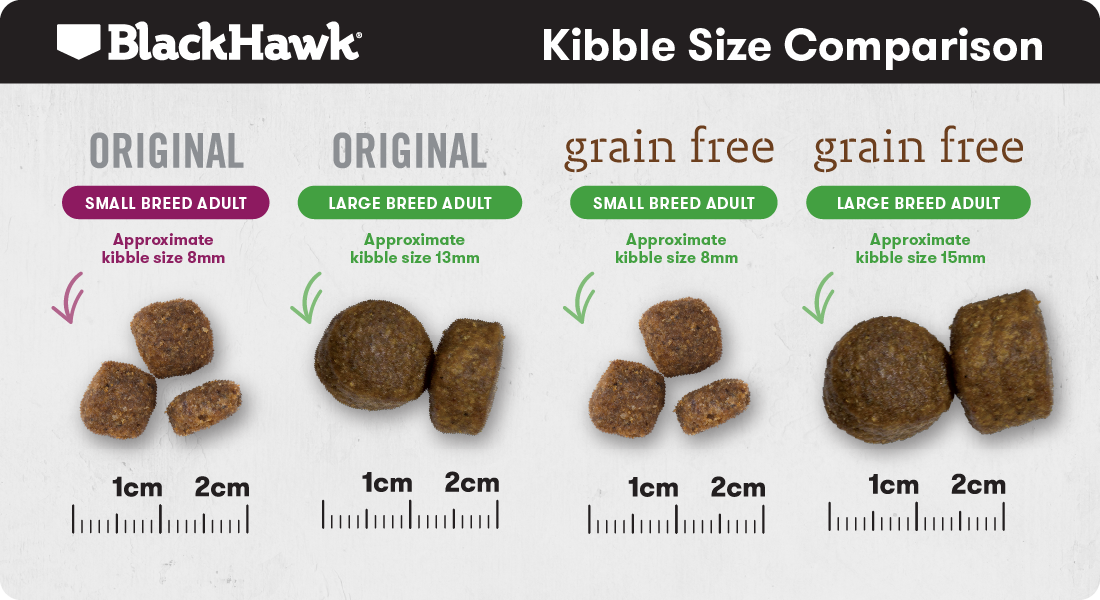
For example, Black Hawk Small Breed Grain Free Chicken features kibble specifically designed for small jaws, compared with the All Breed Grain Free Chicken, which has larger kibble, and the Large Breed Grain Free Chicken, which is suited to bigger teeth and stronger jaws. This bite-sized approach ensures small dogs can chew comfortably, swallow safely, and digest efficiently.
The Benefits of Wet Food
Dry kibble is convenient and may support dental health, but wet foods offer additional benefits for small breeds. Wet food is easier to chew, highly palatable,7 and adds extra moisture to the diet, which can be particularly helpful for hydration.8 Black Hawk’s adult wet foods complement dry kibble perfectly and are ideal for fussy eaters or older dogs with sensitive teeth.
Small vs Large Breed Black Hawk Foods
The differences between Black Hawk small and large breed foods are designed around real, breed-specific needs.
Kibble Size
Small breed foods have smaller, easier-to-chew kibbles. For instance, Small Breed Original Lamb & Rice and Small Breed Grain Free Chicken are shaped and sized for small mouths, whereas Large Breed Original Chicken & Rice and Large Breed Grain Free Chicken have larger kibble suited to big teeth and stronger jaws.
Caloric Density
Small breed formulas are more energy-dense to meet their faster metabolisms without overloading smaller stomachs. For example, Small Breed Original Lamb & Rice provides concentrated energy (3,870 kcal ME/kg), compared with Large Breed Original Chicken & Rice (3,690 kcal ME/kg). This helps ensure small dogs get enough fuel in their smaller portions.
Feeding Guidance
Black Hawk small breed foods include recommended feeding amounts tailored to the smaller stomachs and higher energy needs of small dogs, helping maintain ideal body condition. Large breed feeding guidelines, in contrast, support slower metabolism and the nutritional needs of larger, heavier bodies.
These adjustments are specific to Black Hawk’s products and represent the main scientifically justified differences between small and large breed formulas.
Feeding Tips for Small Breeds
Feeding small breed dogs multiple small meals per day is commonly recommended - especially for puppies and very small adults - due to their higher mass-specific energy requirements and limited stomach capacity. More frequent meals may also help reduce the risk of hypoglycaemia, a condition to which small breeds are particularly susceptible, especially when young.9
Key Takeaways
Small breed dogs aren’t just tiny versions of large dogs. Their teeth, jaws, metabolism, and digestive systems all influence how they eat and what they need. The most noticeable difference is kibble size, which affects chewing, digestion, and dental health. Wet food can provide extra hydration and variety, while Black Hawk small breed formulas - such as Small Breed Grain Free Chicken or Original Lamb & Rice - deliver energy and nutrients perfectly suited to little dogs.
When choosing between small and large breed foods, the key differences in Black Hawk products come down to kibble size, caloric density, and feeding guidance - all scientifically formulated to meet the real needs of small versus large dogs.
References
1. Bąkowski M, Garbiec A, Wojtaś J, Kiczorowska B, Klebaniuk R, Karpiński M. Optimization of dogs’ nutrition — an overview of current research. J Elem. 2024;29(2):517–534. doi:10.5601/jelem.2024.29.1.3244.
2. Middleton RP, Lacroix S, Scott-Boyer MP, Dordevic N, Kennedy AD, Slusky AR, et al. Metabolic differences between dogs of different body sizes. J Nutr Metab. 2017;2017:4535710. PMID: 29225968. doi:10.1155/2017/4535710.
3. Jimenez AG. Physiological underpinnings in life-history trade-offs in man’s most popular selection experiment: the dog. J Comp Physiol B. 2016;186(7):813–827. doi:10.1007/s00360-016-1002-4.
4. Kępińska-Pacelik J, Biel W. Nutritional problems of large and giant breed dogs. Part II. Adult dogs. Folia Pomer. Univ. Technol. Stetin., Agric., Aliment., Pisc., Zootech. 2023;367(66)2:49–63. doi:10.21005/AAPZ2023.66.2.5.
5. Watson ADJ. Diet and periodontal disease in dogs and cats. Aust Vet J. 1994;71(10):313–318. doi:10.1111/j.1751-0813.1994.tb00905.x.
6. Ohtani N, Okamoto Y, Tateishi K, Uchiyama H, Ohta M. Increased feeding speed is associated with higher subsequent sympathetic activity in dogs. PLoS One. 2015;10(11):e0142899. doi:10.1371/journal.pone.0142899.
7. Samant SS, Crandall PG, Jarma Arroyo SE, Seo HS. Dry pet food flavor enhancers and their impact on palatability: a review. Foods. 2021;10(11):2599. doi:10.3390/foods10112599.
8. Yasin S, Awais M, Saleem A, Mobashar M, Ullah Z, Ali U, et al. Dog food: Choosing the right food for your dog. In: Nutritional Foundations of Holistic Health: From Supplements to Feed Strategies. Unique Scientific Publishers; 2025. doi:10.47278/book.HH/2025.248.
9. Idowu O, Heading K. Hypoglycemia in dogs: causes, management, and diagnosis. Can Vet J. 2018;59(6):642–649. PMID: 29910479; PMCID: PMC5949948.